Check out this new site:
Take a Quantum Leap with me…
… back to the year 30 AD
Yes – we’re talking time travel! The thing of science fiction, Hollywood and nerd scientists. Between H. G. Wells and Albert Einstein scientists and fiction writers opened our minds and consciousness simulating our imaginations, releasing scores of dreams and visions. The speed of light – the laws of space and time – the theory of relativity – quantum physics – Casimir energy – Einstein-Rosen bridges – black holes – phantom Energy – Kerr Rings – wormholes – cosmic strings – Alcubierre drives – quantum foam… lions and tigers and bears – oh my!
And we haven’t even thought about the ‘time-travel’ paradoxes yet!
“Paradox,” you say. “What a ‘time-travel’ paradox?”
Nothing much – just think about a time traveler going back in time to kill himself as an infant. If he were to do so, he never would have grown up to go back in time to kill himself as an infant, so how could he…. But, that can’t happen you say. I know…I know.
Oh yes – our imaginations are soaring (as well as national aspirin sales).
Believe it or not, it’s easy to travel in time – going forward. You see, travelling at or near the speed of light transports you into the future! Oh yes – it’s pure physics.
So, to travel in time – all one has to do is travel fast – very, very fast!
The fastest manned vehicle in history was Apollo 10 which traveled at speeds of 25,000 miles per hour.
 To travel forward in time you only have to go 2000 times faster than that. Go any slower and you’ll be sucked into a black hole.
This is due to a strange fact about the universe. There’s a cosmic speed limit, 186,000 miles per second, also known as the speed of light. Nothing can exceed that speed. It’s one of the best established principles in science.
Ok – so what’s the problem? Well – to travel backwards in time – now that’s a different story…
If you think about it, we’re all constantly engaged in the act of time travel. At its most basic level, time is the rate of change in the universe — and like it or not, we are constantly undergoing change. The planets move around the sun, the sun moves in the galaxy, you and I age – things change.
We measure the passage of time in seconds, minutes, hours and years, but this doesn’t mean time flows at that nice convenient, constant rate. Just as the water in a river rushes or slows depending on the size of the channel, time flows at different rates in different places. In other words, time is relative.
So time travel comes down to the relationship between time and space. Human beings exist in three spatial dimensions of length, width and depth. Time joins the party as that most crucial fourth dimension. Time can’t exist without space, and space can’t exist without time. The two exist as one: the space-time continuum. Any event that occurs in the universe has to involve both space and time.
Just think about this: The Milky Way galaxy is roughly 100,000 light-years wide, so light from its more distant stars can take thousands upon thousands of years to reach Earth. So, seeing that light is essentially looking back in time. When astronomers measure the cosmic microwave background radiation, they are staring back more than all of known time into a primordial cosmic age. Yes – that’s time travel – my friend – time travel.
While there’s nothing in Einstein’s Theory of Relativity that precludes time travel, it’s not as simple as turning a dial on some shaking contraction  or stepping into a ‘wardrobe’. Further, once the science is addressed and overcome (yeah- right!), the very premise of pushing a button and going back to yesterday violates the law of causality, better known as cause and effect.
You know ‘cause and effect’ – the idea that when an event happens in our universe, it leads to yet another event in an endless one-way string of events. Here’s the law: In every instance, the cause occurs before the effect – at least in our universe it does. Think not?Just try to imagine a different reality, say, in which a murder victim dies of his or her gunshot wound before being shot. It violates reality as we know it; thus, many scientists dismiss time travel into the past as an impossibility.
But – is that the end of the story? ….Or is it just the beginning….
A clay tablet dating from the 1st Century in ancient Israel is uncovered.
There is writing on it – a name – in English – from the 21st Century!!!
Solving the mystery of the Pyramids…
“David…what do you know about the pyramids?” Alex asked.
“Not much, about what most people know, I guess.”
“And what would that be?”
“Well, let’s see, they’re in Egypt; built by the pharaohs thousands of years ago, as their burial tombs.”
“That’s it?”
“Yeah, I guess it is,” he said. “Oh, they were built by slaves, and Charleston Heston set them free. You know, “let my people go.”
Alex failed to see the humor, “Yes, it makes good theater, seeing hundreds of slaves pulling a massive block of stone up a ramp on the side of a pyramid—but it’s all rubbish…”
Alex shook his head in disgust, “The world has been fed a diet of lies and deception about the pyramids and has swallowed it hook, line and sinker. It’s insulting to the ingenuity of these great structures, the lack of respect they receive.” Pushing back from the table, he stood, “it’s all there, in front of our eyes, the ancient ones left it all in place for us to see and we refuse to. The pyramids have stood as open scrape books of their civilization, and we reject their existence.” He paused, looking directly at David, “do you realize there is no modern engineering feat that comes close to the pyramids?”
“…Because the pyramids look like a pile of rocks, people tend to dismiss them. There are over 2 million blocks in the Great Pyramid of Giza alone, some weighting upwards of 70 tons. That pyramid stood 481 feet high with each side measuring 756 feet with a maximum deviation of less than 1 inch. The sides are curved in to match the curvature of the earth and rise at a precise angle of 51⁰ 52’ with a deviation of less than five-hundreds of one percent of degree. Amazing, since people didn’t even believe the earth was round until thousands of years later…
“…I could go on with more facts about the construction of each of the three major pyramids in Egypt that would confound your modern engineering mind, but their construction is only the tip of the iceberg, just the beginning of the marvel. There is a much greater mystery to them. How the pyramids were built is a question that’s asked repeatedly, but it’s the wrong question. A better question is: ‘Why were they built?’ Why are they scattered randomly across the middle of open desert? Such a massive construction effort…why?”
“I can tell you for certain why they weren’t built. They weren’t built to be tombs. Not only have no mummies ever been found in them, but they wouldn’t go to so much detail, precision and work to build a tomb in the desert. And, it’s my opinion; they never contemplated such a thing because…they never planned on dying. They intended to live forever.” (except from “Beneath the Turbulence”)
…the code of the Zodiac Constellations…
“To understand the pyramids David, we need to put aside the material marvel they are and look at the cosmic marvel they are, something Allen showed me.”
“…The Great Pyramid was aligned, by its architects, to be exactly one-third the distance between the equator and the North Pole and is an exact mathematical relationship of the dimensions of the earth. This is truly remarkable for people who didn’t know the earth was round, much less the true size and shape of it! Its north-south axis is aligned to within three-sixtieths of a single degree of true north. David, that’s more accurate than the Greenwich Observatory in London! To position a structure that covers over 53,000 square meters to that precision is not possible today; so how was it done then? The pyramids are a precise mathematical model of the earth. Again, it begs the questions, not only how, but why? Why be so precise for a mausoleum sitting in the middle of the desert? A tomb? Calling the Great Pyramid a tomb is like calling the Buckingham Palace an outhouse. I could spend the next week with scores of facts that would prove false any contention that they were built as tombs by the Pharaohs of Egypt. We haven’t the time for that, and it’s not necessary to show you what they’re not built for—I’d rather show you what they were built for…”
“…The Sphinx had the body of a lion and the head of a man, crouching there, for thousands of years. Why David? What’s it doing? What’s it for? Why was it built? It’s not placed randomly but is precisely aligned with the rising horizon to the east. Precisely David, not close—but exact. Again it begs the questions, ‘Why bother? Why use such unwieldy sizes and materials? Why such precision? Why such meticulous design? Why?” (except from “Beneath the Turbulence”)

…and a unique form of gold found on the moon during the Apollo 17 mission…
All come together in a travel corridor—a corridor that goes back 2000 years to the year 30AD – to the time of Jesus of Nazareth.
“So, if I’m not a time traveler, and didn’t write those tablets—then who did?”
“But David, who said you didn’t write them?” He was surprised it was Allen who spoke.
“What’s that supposed to mean? Your interrogation proved I didn’t do it.”
Allen answered meticulously, measuring every word as if listing the factors of a mathematical equation, “That’s correct…it proved…you… didn’t do it…yet.”
David was stunned, “Yet? What’s that mean? You still think I did it?”
“No…we think you…will do it.”
“But, you said you believed me that I don’t have a time machine.”
“That’s true; we believe you have no such device.”
“Yet, you think somehow I came here from 2000 years ago?”
“No, we believe you came here from now, but you’re going to go back to 2000 years ago.”
…David looked around at the group, “You guys have built a time machine, haven’t you? That’s what this is all about, isn’t it?”
“No, we haven’t built a time machine, and I don’t believe such a machine can be built,” Allen answered, “but we may have found a time machine, and have figured out how to use it and how such travel was done.” (except from “Beneath the Turbulence”)
Is this for real? Is this a hoax? Or a ruse – hiding a terrorist cell planning massive mayhem and destruction?
A determined group of scientists wants to know. An avowed atheist, also want to reluctantly know…and the Department of Homeland Security wants to know.
Travel with this dysfunctional team as they journey through this time corridor to 1st Century Israel, dodging Egyptian warriors, Roman legionnaires and a country in turmoil, to find the evidence of who the man called Jesus really was. Was he a crazed man with his own agenda? A deluded prophet? A liar and fraud? Or was he actually who he claimed to be – the Son of God?
An uninvited traveler journeys with them, bent on a private mission of revenge and personal glory. If they can make the return journey back to the 21st Century, what they discover and reveal will not only impact the world but will change each of their lives for eternity.
“Beneath the Turbulence” – an exciting, simulating and invigorating story of time-travel and history is presented in two volumes, both volumes are included in the book. 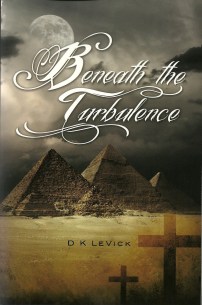
Volume One: “The Journey” describes the science driving the journey back in time, coupled with the suspense of evading the Department of Homeland Security, who considers them potential terrorists. ,
Volume Two: “The Journal” chronicles the trials and adventures encountered while seeking the truth of Jesus traveling in First Century Egypt and Israel under Roman rule.
Click on the cover to get your copy today.
 Until Next time – Embrace your Bridges – for they define who you are.
Posted in Belief, faith, trust, Book Reviews, christian fiction, Christianity, clocks, historical fiction, Historical Trails, History, Inspirations, Life, Living, Original Fiction, pyramids, Reading, Science, Things to Ponder, time travel, Uncategorized | Tagged adventure, christian fiction, God, historical fiction, Jesus, life, mystery, peace, time travel | Leave a Comment »
A Roman Tribune plays the role of Columbo in the most famous game of “CLUE” known to the world, called – “Where’s the body?”
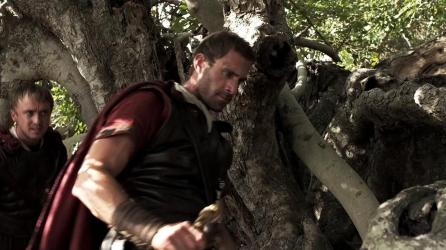
We all know the story of the empty tomb – the excited women – the missing “Messiah”. That is – we all know it from that side of the tomb.
But, what was it like from the other side? The Roman side of an empty grave? The tomb that was sealed with the Roman Governor’s seal and guarded with Roman soldiers?
‘RISEN’ has taken up the challenge in resolving the mystery.
“I’m yet sticky with filth.”
Thus said the Tribune Clavius when summoned to Pontius Pilate. And thus sets our understanding of Clavius’s soul – ‘yet sticky with filth’.
Clavius, a role portrayed with depth and sensitivity by Joseph Fiennes, is accustomed to brutality, bloody combat and death, but not without a price. He is drained, depleted, battle weary and emotionally dead. In the opening battle scene, he brutally kills a Jewish rebel leader, named Barabbas. (“Barabbas”? Is that coincidental or is that God’s way of evening up the score?) The constant gore and butchery of quelling those pesky Jewish insurrections in a remote, desolate land far from the ‘action’ of Rome, has taken its toll, robbing him of hope and peace, leaving him numb and yearning for nothing more than…
“…a day without death.”
Upon returning to the Antonio Fortress, (interestingly placed below the old city of Jerusalem), his day isn’t quite over yet. He is summoned by the Governor, something that happens all too often. It seems Pilate “has a situation” and he needs Clavius to tidy up the loose ends. Those “raving Jews” wanted a man named Yeshua, who claimed to be the “messiah” disposed of.
“I had to crucify him,” Pilate says almost regrettably, (a sentiment one finds hard to accept knowing the history of this brutal dictator who crucified and slaughtered thousands).
Clavius ensures that Yeshua is dead and securely buried in a sealed tomb with Roman guards posted.
End of story – right?
No – of course not – it’s only the beginning. The inevitable happens – the body doesn’t remain in the tomb.
Let the games begin – after all – we can’t have dead people walking about – can we?
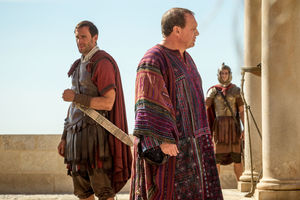 “We must find the body,” Pilate raves. “Find the corpse of this cursed Yeshua before it rots.”
Exploded frayed ropes – two anemic looking drunken guards – discarded, bloody grave clothes – a stone tossed aside – lies and bribes from the Sanhedrin – all lead to …nothing…no body.
Does Clavius ever find his missing body? Oh yes – with a little twisting of the arm and a bag of coins, Yeshua’s disciples are found. And they did, in fact, have the body with them.
Only – the body isn’t dead, but is very much alive, and in a scene straight out of The Twilight Zone, this hardened Roman warrior melts into the stone wall as he encounters the true power of God in the flesh. This moment just happens to coincide with the arrival of ‘doubting’ Thomas. While he probes the wounds in the wrists and side of the Messiah, the eyes of a smiling Yeshua probe deep into the soul of the Tribune.
What do you do when you encounter the impossible? He does the only thing he can do – he follows the walking dead man. In this case it means following the followers of Yeshua, like a stray, lost dog; finding acceptance among them, and ultimately – friendship.
When finally he is alone with the murdered, living man, Yeshua asks him what he seeks in life, and then answers his own question:
“A day with no death?”
Clavius leaves all behind – to travel a new road – to places we know not of – but with a new found peace, after witnessing the ascension of Jesus and hearing His great commission.
We are set up for a sequel – as we know not where Clavius is going or what roads lie ahead for him.
‘Risen’ is excellent historical fiction that intertwines Biblical scripture with “what might have been”. The historical is historical and the fiction is fiction – and in those scenes where the two intermix, the purity of the Scriptures was not compromised. One area where liberties were taken, was the reference to Mary Magdalene being a quite popular “woman of the streets”. This was based on church tradition and finds no merit in Scripture.
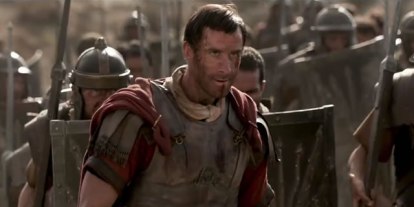 The battle scene, Roman soldier dress, weapons and warfare was as realistic as ever shown, and Jewish culture along with Sanhedrin attire and demeanors were portrayed as accurately as history tells us.
The portrayal of crucifixions reflected the known information of such executions.
Jesus is shown smiling, laughing and gracious. He is a miracle worker and His disciples love Him as their father and leader. When Bartholomew (who would have fit right in on a California beach as a surfer dude) is threatened with crucifixion himself, he spreads open his arms and laughingly replies: “I would happily submit”.
Clavius sums it all up by leaving his life behind, saying “I believe. I can never be the same.”
‘Risen’ does something the previous stories of Jesus failed to do: it makes the non-believer pause and think about the resurrection from an outsider perspective. It’s not the usual scenes of blinding lights and rolling thunder with the women running about in alarm. No, rather it presents a barren, empty tomb and proceeds to answer the question that Pontius Pilate asked:
“How could he follow a Hebrew?”
Watching Clavius undergo a life-altering transformation, leads us to one answer – the one that Lucius, Clavius’s protégé, hesitantly offers to Pilate:
“Perhaps it is true.”
Amen – brother – Amen.
Until Next time – Embrace your Bridges – for they define who you are.
Posted in Belief, faith, trust, Christianity, DK's Journal, Easter, Historical Trails, History, Inspirations, Life, Living, Movie Review, Original Fiction, Risen, Things to Ponder | Tagged adventure, character, dklevick, God, historical fiction, life, Movie Review, mystery, peace, Resurrection, Risen, writing | Leave a Comment »
In September of 2013, I published a post entitled “Let us be Redwoods” . Please take a moment to click on it and then come on back, ok? I’ll wait here for you….
….Okay – ready? Thanks.

 Last week, 2 1/2 years after the original post, I reposted it? Why you may ask?
Good question – it’s one I asked myself while doing it without really knowing the answer.
“Why am I resending this?”
For some reason I felt a strong pull inside telling me to repost it. It literally, popped into my head to do it. Weird.
In addition to that, for the last few weeks the ‘Shema‘ has been on my mind.
“Hear, O Israel: The Lord our God, the Lord is one! You shall love the Lord your God with all your heart, with all your soul, and with all your strength. And these words which I command you today shall be in your heart. You shall teach them diligently to your children, and shall talk of them when you sit in your house, when you walk by the way, when you lie down, and when you rise up…” Deuteronomy 6:4-8
Yesterday, I think I heard the answer.
“ONE” was the message spoken by my pastor this morning. He quoted the opening of the ‘Shema’ and also these words prayed by Jesus:
“I do not pray for these alone, but also for those who will believe in Me through their word; that they all may be one, as You, Father, are in Me, and I in You; that they also may be one in Us, that the world may believe that You sent Me.“ John 20:20-21
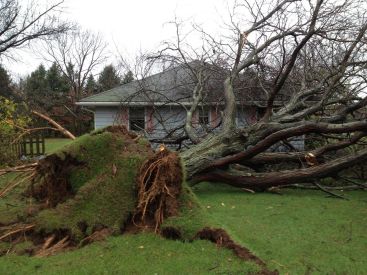
Th mighty oak is a strong and powerful tree. It’s roots burrow deep into the ground – 30, 40 even 50 feet down in the earth, grabbing firm in a death-defying life grip. When the storms come, with the turbulence, the assault and the violence, they bend, twist, crack and snap in the raging, swirling winds.

And though they are mighty and stong, the tree can break free from its grip on the earth, and slowly, steadedly pull up and away from the deep roots, tearing up the ground, cracking, ripping, smashing – crashing to the forest floor in a hunderous explosion of brokenness, destruction and death.
Do you know how high 300 feet is straight up? It’s a football field stood on end.
The Statue of Liberty is 305 feet high.

How high is The Leaning Tower of Pisa? The Capitol Building? The Tower of Big Ben?
Redwood trees grows to heights greater than 300 feet – exceeding 360 and 370. Imagine a single tree towering over our Lady of Liberty! Here – take a look…

If we were to design such a tree, our ‘educated’, logical, scientific brains would think that we drive the roots of the Redwood down into the bowels of the earth itself in order to keep it standing during the storms (storms? just sheer weight and gravity should make it topple over like a top!). But, as we know – that is not the case. Their roots are only two to three feet deep! Can you imagine a 370 foot tree being supported and held up by 3 feet of roots? It defies logic – science and engineering. Think if the Leaning Tower of Pisa only had a two foot foundation!
The Redwood Tree is not only an amazing example of God’s creative genius and power, but it’s the revealed answer to God’s riddle of “ONE”!
“No way” – you say. In the forest there are many redwood trees and each are individual, stand alone trees. “Ain’t no riddle there mister, sorry don’t see the connection fella.

Oh, but our eyes only see on the surface – it’s under the surface that we find the answer to the Redwood’s success – and it’s there where we find the “ONE”.

Yes – there are many Redwood trees – that’s the beauty of it – they survive. Many trees – and each is an individual – each tall, straight and strong. Each having its own root system. It’s shallow, to be sure – only digging 2 to 3 feet into the earth – but those roots spread out – interwine – connect – even fuse with the roots of its neighbor – forming – you guessed it – “ONE” unified, solid community foundation where “ONE” supports “ALL” and “ALL” supports “ONE”.

When the storm rages against any single tree – it’s raging against the community – against a unified mat that withstands and defeats any and all storms. God’s love is the sap that fuses the roots together!
And here’s another thought to chew on: High above – overhead in the sky – the redwoods form a protective canopy – a covering – that shelters the oak, the pine, the hemlock and the beech tree – providing them cover from the storm. Think of those trees with the deep roots – that are looked to for their fruit – (our pastors and leaders) – they have refuge and shelter under the canopy of the shallow rooted redwoods (the flock)!
Scripture tells us to be “rooted” in the word and to “love” one another with the “love of God”. That “love” is the ‘sap’ that flows through the roots, fusing and joining together all the community of God.

What a marvelous mystery God has given us!

Until Next time – Embrace your Bridges – for they define who you are.
Posted in Christianity, Creation, DK's Journal, Hiking, Inspirations, Land, Life, Living, nature, Science, Things to Ponder, trees | Tagged character, God, life, mystery, trees | 2 Comments »
I’m reposting a blog from a ways backin time that I feel will bless you today.
duane

The glory and splendor of a tree is an awesome sight.
You know what I’m saying. We’ve all been there, standing in awe, gazing up, marveling upon a tall, straight, full tree as it sways in the breeze, gently singing its soothing song of peace and goodness to the land. The creatures of the earth and birds of all sizes, designs and colors finding refuge in its thick, life-sustaining foliage.
We look upon the Maple – the Beech – the Sycamore and the mighty Oak as they rise upwards – 60 – 80 – even a hundred feet towards the light, and we marvel at their strength and beauty. They stand firm and steady against the winds, rains and hails that batter them. Their roots go down deep into the ground, 20 -40 even 80 feet to anchor them securely to the earth, holding them tight against the storms of…
View original post 669 more words
Posted in Uncategorized | Leave a Comment »
Recently I had an interesting discussion with a good friend regarding the above statement. We tossed around words like “believe” and “faith” and traveled down the many divergent paths those roads lead to. It boiled down to a basic question:
“Is believing in something the same as having faith in something?”
What do you think?
Is there a difference between the two? If no – then why not? If yes – then what?
Why don’t you take a second or two and think about it…
Hmmmmmmmmmmmm Zzzzzzzzzzzzzzzzzzzzzzzzzzzzzzzzzzzzz
Okay, that’s enough – times up – what did you come up with?
Have you ever been to Niagara Falls? Should go – something marvelous to see – but more so to feel. You may recall that a few years back the famous daredevil, Wallenda, walked across the Horseshoe Falls. It was on TV and was an amazing feat to watch, sitting on the edge of my seat with my heart in my throat.
It seems there’s always been a special attraction for watching those daring souls venture across the mighty Niagara on a wire or rope. There has been a stream of ‘rope walkers’ doing crazy things over Niagara ever since we called it “Niagara”.
“The good pictures were of those guys who walked across the gorge on tightrope. Of course, they weren’t ropes at all but wires (why didn’t they call them “tightwires”?), and everyone always said those guys walked across Niagara Falls, but I’d never seen a picture of anyone doing that. It was always the gorge they walked across, away from the Falls. No matter, these guys were amazing. They did everything out there on those wires, suspended over the middle of the gorge with that wild river below them.” Journeys Across Niagara
Check out the picture below.

For those of you who aren’t familiar with Niagara Falls and its history, that’s the famous Blondin, considered the greatest wirerope walker who ever lived. He was born Jean Francois Gravelot, on February 28th, 1824 in St. Omer, Pas de Calais in Northern France. Blondin came to Niagara in early 1858.
He was obsessed with crossing the Niagara on a tightrope and on June 30th 1859, he became the first person to amaze the world by successfully walking over the Niagara Gorge. He utilized a 1,100 foot long – 3 inch diameter manila rope stretched from what is now Prospect Park in Niagara Falls, New York to what is now Oakes Garden in Niagara Falls, Ontario. During that historic summer of 1859, Blondin completed eight more crossings.
The following year, on September 15th, 1860, he once again precariously inched his way across the swirling, violent waters roaring below, traveling from America to Canada.
As Blondin stepped off the rope, the amazement of the crowd erupted into a roar of cheers, applause and shouts. As it subsided, Blondin spoke.
“Do you believe I can cross back over the falls again?” he asked.
The crowd yelled enthusiacticly back, “Yes! Yes, you can! We believe.”
Blondin responded, “Do you believe I could cross back over carrying a man on my back?”
The crowd roared back in reply, “Yes! Yes, we believe!”
Blondin asked, “Okay – who will volunteer to go with me?”
The crowd was silent.
Blondin pointed to an onlooker nearby and asked, “Will you?”
The onlooker shook his head violently – “No – not me”.
“Will you?” He asked, pointing to another admirer.
“Uh – Umm – No, I can’t….No”
“Is there anyone who will trust me?”
Silence.
Blondin turned to his manager, Harry Colcord. “Harry, do you believe I can carry you across?” he asked.
“Yes, Charles, I believe you can,” Harry replied.
“Then will you trust me to climb onto my back?” Charles asked.
Harry replied, “I will.”
Harry Colcord stepped onto the platform with Blondin and climbed onto his back.
“Sit still and don’t move” Blondin said, “Just let me walk. I got you and I won’t let you fall.”
Blondin, with his balancing pole in hand, slowly began to walk back across the Falls.
Half way across, some of the guy ropes holding the manila ‘tightrope’ snapped, loosening the ‘tightrope’ and allowing more sway in the wind and mist.

Stepping onto the platform on the American side, Blondin became the greatest tightrope walker in history.
So, i ask again, “Is Belief Enough”?
“For God so loved the world that he gave his one and only Son, that whoever believes in him shall not perish but have eternal life.” -John 3:16
This is the basis of Christianity–our promise – our hope and our salvation – the requirement for eternal life. In light of the story of Blondin, it begs the question about the meaning of the word “believe.”
The ‘believers’ in the crowd that day believed Blondin could cross Niagara carrying a man. Yet, when Blondin asked for someone to go with him, belief was no longer sufficient to make the journey. For someone to put their life in Blondin’s hands, and become one with him on the rope, required something more than belief.
It required pisteuo, Faith.
It takes Trust.
The Greek word for “believe” used in John 3:16 is pisteuo. While “believe” is the best English word we have for pisteuo, in the Greek, it evokes a deeply held form of belief that implies acting on the belief. A better translation would be “belief with unhindered trust.”
While Harry Colcord believed in Charles Blondin, he took it further. He acted on his belief with faith and trust when he climbed onto Blondin’s back. The entire crowd believed in Blondin, but only Harry had faith enough to trust him – to step out from the crowd, taking his belief to an active level of faith and trust.
Trust was the difference! Trust is belief set in motion by faith.
Does God call us to only believe in Him while standing in the crowd? Or does He call us to step out in faith, to trust Him and walk with Him. (Notice there was no crowd out on the ‘tightrope’.)
He’s asks, “Will you trust me?”
So what does trust look like? Many people believe in Jesus with their mind, but if He pointed at them to ask if they trusted him to carry them, they’d recoil and say “Not today, I can’t risk my life like that!”
Notice – He doesn’t ask us to walk across the ‘abyss’ alone. Oh no, He just asks us to have faith and trust Him while He carries us across the ‘abyss’. We don’t need to know how to walk – we just need to put our trust in Him and let Him do the walking.
Whatever our situation is, the answer is simple–trust Him. He has proven he is trustworthy. He has shown us that. He allowed Himself to die for us – when He could have ended it at any time. He is calling us to step out on faith–to become one with Him as He carries us across the perilous gulf of this world.
His hand is outstretched and He asks, “Do you trust Me?”
So – what do you think?
Until Next time – Embrace your Bridges – for they define who you are.
Posted in Belief, faith, trust, Christianity, DK's Journal, Historical Trails, Life, Living, Things to Ponder | 2 Comments »
|
||||||
|



Posted in Uncategorized | Leave a Comment »
|
||||||
|
Posted in AIDS, Christianity, DK's Journal, Historical Trails, History, Inspirations, Life, Living, Things to Ponder | Tagged an old man does technology, blogging, character, dklevick, life, Thanksgiving | Leave a Comment »
I don’t write about politics – it’s not my thing and basically I don’t really like it or politicians.
But, this time I can’t sit back and bite my lip – my teeth are grinding on one another!
Last night, I watched on the news as the world “rejoiced” that a great “never before” – “first-time” negotiations had concluded with a “deal” with Iran.
Hmmmm- let’s see if I have this right:
Iran will “halt” “part” of its nuclear development program and in exchange we’ll lift our sanctions against it and provide humanitarian relief.
Now, the press can goggle and salivatate all they want over this, but does anyone honestly believe Iran is going to halt development of their nuclear program? They have continually and openly defied the world on this subject from day one – and lying about it is right out of their playbook. Anyone with eyes to see and ears to hear knows better. Iran has openly and blatently worked with North Korea on this and our own intelligence has reported what their true aim is. But we hide our heads in the sand and pretend.
But – that’s not my issue with this.
There is an innocent American citizen who has been held prisoner in the worse Iranian prison for over a year. They want to keep him there for another 7 years.
I said “AN AMERICAN CITIZEN”!!
He has been tortured, beat, deprived of medical help and medicine, and treated less than an animal – and for no other reason than that he refuses to denounce his faith – Christianity. That’s it! No – he wasn’t preaching on the street corners – he wasn’t out defying their government. In fact, he was there supporting their orphanages. You know – the children suffering from their abusive beliefs and hatreds!
Yes – the same people we know agreed to send “humanitarian” aid to!
Hundreds of thousands of people have written and requested Iran to release him. Their response? They moved him to a worse prison that has a legacy of death and coming out in a box.
I have two questions for both – the politicians who “negotiated” this earth-shattering deal and for the press that slobbers all over it and over those politicians:
First – WHY WASN’T THE RELEASE OF PASTOR SAEED ABEDINI EITHER A PRECONDITION TO SITTING DOWN WITH THEM OR AT LEAST A PART OF THE AGREEMENT?
Second – WHY IS THE UNITED STATES SITTING AT A TABLE TO NEGOTIATE WITH TERRORISTS THAT ARE HOLDING AMERICAN CITIZENS IN A TORTUROUS PRISON?
It is unconsciousable that our government held these negotiations without demanding the release of Pastor Saeed – a U.S. citizen! Why wasn’t his release a precondition for us to even sit down with them to negotiate?
Instead – we’re going to relax sanctions and providing humanitarian relief.
“Humanitarian relief”!
Are we living in Disneyland?
Have the politicians and the press forgotten that Iran has been in a state of armed conflict against the U.S. for decades? It is common knowledge – stated by these same politicians and reporters – that Iran has killed Americans directly and supported every terrorist group, country and cause against America and is the main supplier of arms to jihadist terrorists in Iraq and Afghanistan.
They kill Americans.
They want all Americans dead. That’s not me saying that – they say it themselves – with a smile on their face.
They hold American citizens in hell-hole prisons for no reason other than they don’t agree with them. And we negotiate with them – give them aid – and “humanitarian relief”! Tell me – how do we make a deal with people who are torturing our citizens?
Yes Virginia – there is a Santa Claus.
He lives in the White House and he negotiates with terrorists, but he doesn’t give gifts of freedom to all equally.
One man – a husband – a father – a pastor – sits in prison – won’t see Christmas – or his family – or his country. He’s held captive by the Grinch who Stole his Christmas – while the world applauds the Grinch and takes pictures of the Grinch shaking Santa’s hand.
Strange – how this President can care so much about certain Americans and so little about other Americans. I’ve seen a number of presidents in my time and I don’t recall them being so selective about who they champion or not.
Stranger still – is how the American press can so totally work the country into a frenzy about some isolated criminal incident and so totally ignore Americans being killed, tortured and forsaken by the same people we honor and heap “humanitarian relief” on.
We all need to pray for Pastor Saeed – because our prayers are the only support he’s getting.

Posted in Christianity, DK's Journal, Life, Pastor Saeed, Persecution, Politics, Things to Ponder, Uncategorized | Tagged dklevick, life, politics, prison, Saeed | Leave a Comment »


YES – it’s TRUE!
FAWN – Fighting AIDS With Nutrition
is hosting its second
Christmas Concert
and
YOU’RE INVITED!

is coming back to Melvindale!

Everyone is Invited!
Invite Family! Invite Friends! Invite people you don’t know!
Invite everyone! For an evening of that classic, d0-wop Motown Music.
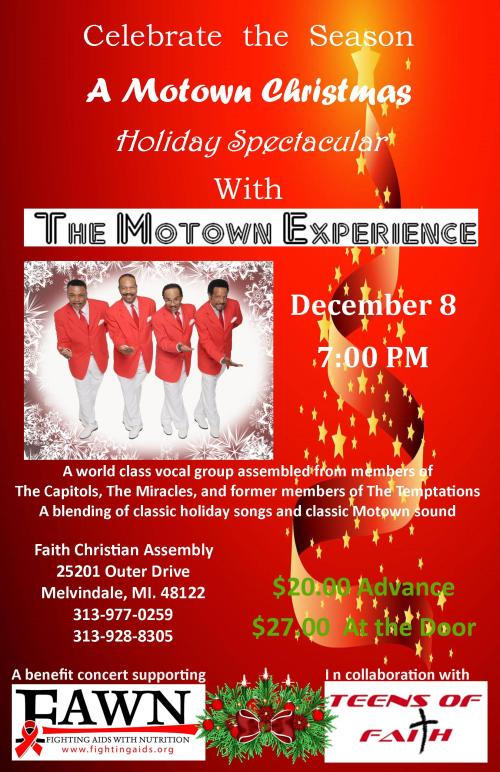
Consisting of members of the Miracles – the Capitals – former members of The Temptations – The Motown Experience provides a world-class vocal and visual night of song, rhythm and entertainment that you don’t want to miss.

They’re still talking about last year’s concert!
This year’s performance promises to be even better blending together your favorite Christmas Classics with that distinct Motown sound.
Don’t be one of those unlucky ones who only get to talk about what they missed – next year!
The Motown Experience Christmas Concert is brought to you by:

and

Location:
Faith Christian Assembly
25201 Outer Drive
Melvindale
Tickets cost $20 – advance and $27 at the door

So – Get your tickets early and safe dollars!
Tickets can be purchased by calling 313-977-0259
Posted in Uncategorized | 2 Comments »
-
Join 6,763 other subscribers
- Follow D.K. LeVick's "Writing in the Woods" on WordPress.com

Available on Amazon or from author

The stickman ran in 2006 – Can he run again? For a great cause? Only with your help…
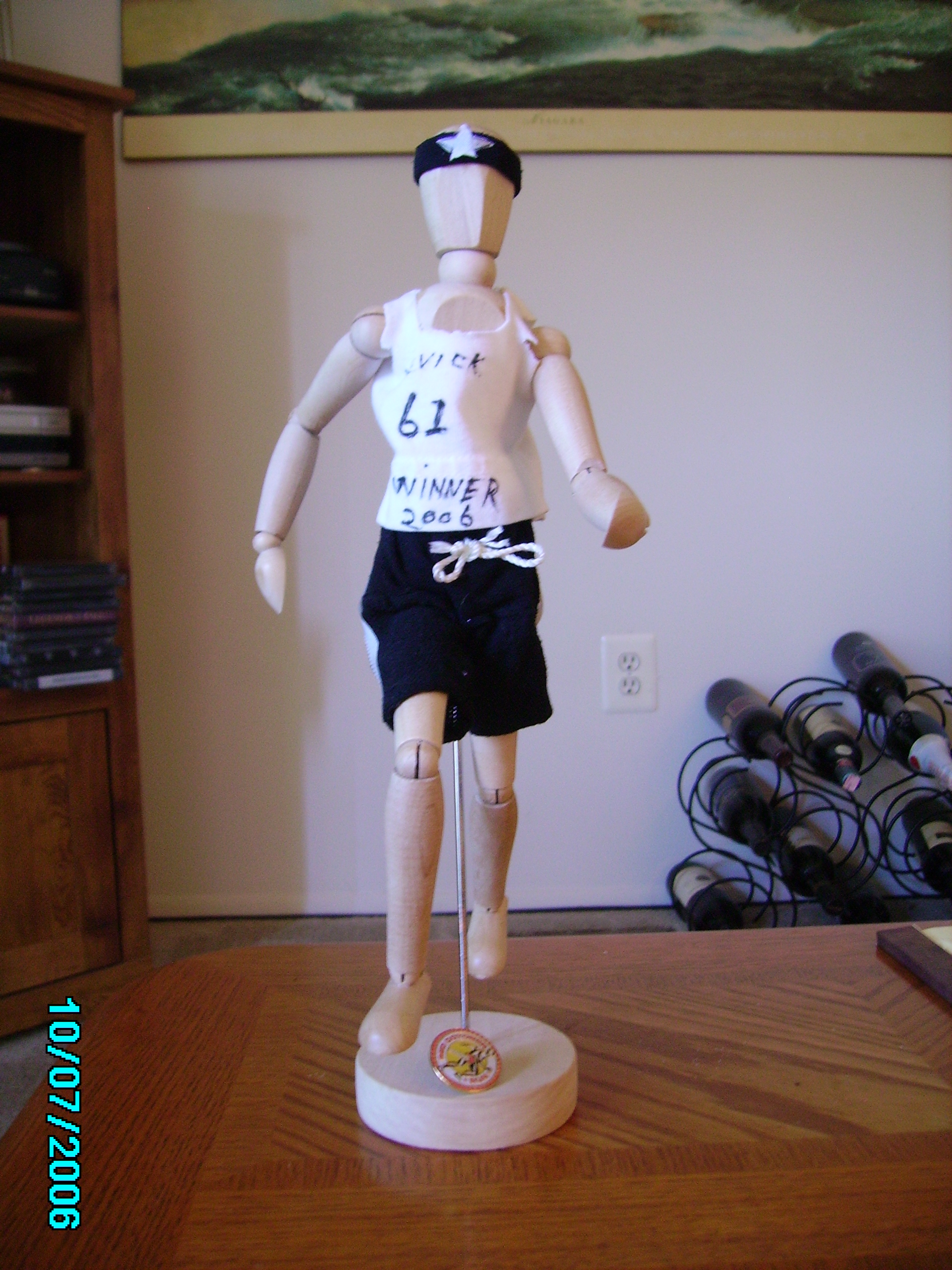
2016 Half Marathon run for World Vision – donate!!

For the Children! Click on image to donate - thank you!
Available from the author: duanelevick2011@gmail.com

'Journeys Across Niagara: The Flute, The Feather and the Drum' is available for purchase from the author
2011 Silver Medal Winner: Young Adult General Fiction

Bridges - a Tale of Niagara (Original Version of 'Journeys Across Niagara')
2011 Finalist Award: Adult Fiction

Bridges - a Tale of Niagara (Original Version of 'Journeys Across Niagara')
-
Recent Posts
- Imprints – Personalizations
- Time-travel: Wanna go?
- A First Century Mystery
- The Redwood – Revisited
- LET US BE REDWOODS!
- “I Believe – therefore I have Faith.” Hmmm.
- Happy Thanksgiving
- Being Thankful is being Committed
- Iranian “Deal” leaves Saeed in Prison
- FAWN Christmas Concert
- FAWN Thanksgiving!
- FAWN goes to College
- Beneath the Turbulence
- FAWN – Fighting AIDS With Nutrition
- Scientists and Believers – Why is there a War?
- Who Winds Your Clock?
- The sound of Silence
- Don’t let a Tragedy – keep you from the ‘Land of Promise’
- LET US BE REDWOODS!
- A Shouting Moment!
- Translation is Such Fun!
- Heinz 57 Religion
- If there’s a watch – then there’s a watchmaker.
- The Devil’s in the Details or How an atheist knows there’s a God
- WAS JESUS REALLY THE ‘SON OF GOD’?
- The Spirit of Blondin Lives in Wallenda!
- A ‘River Rat’ and a Raft
- You Be The Judge
- The Niagara River – a Wonder of Creation
- ‘Journeys Across Niagara’
- Research – the Writer’s Mantra
- The Journey of ‘Journeys Across Niagara’
- The Color of Christmas
- Stepping out of the Boat
- Atomic Clock
- WAS THERE REALLY A ‘HERMIT OF NIAGARA’?
- Silver Metal Award !!
- Nothing like The Feel of a book in Your Head
- A Gift for you
- Book Review: THE TRUST by Sean Keefer
Archives
Looking for me?
adventure advisers ambivalence an old man does technology bible blog blogging book future book review bridges cathedral cavemen character City of Dreams creation daredevils dklevick ebook publishing ebooks end of world erie canal facebook falls geriatrics God gorge grief hermit of niagara hiking historical fiction history honey mead honeymoon Indians Iroquois Journeys Across Niagara Kerwin Swint kings LaSalle legends life Maid of the Mist michigan miracle mystery nature niagara niagara falls old man On-Writing outdoors overcoming peace photography prison publishing reflection river schooner solitude Stephen King stunts supernatural technology Thanksgiving The King Whisperers tourists trees trouble tweeter White Canoe William Martin wny woods writingA-tweeting we will go:
Tweets by dk_levickAlso on Amazon by D.K. Levick: ‘Potatoes’

In 'Potatoes,' an old man revisits the site of an accident.
Also on Amazon by D.K. Levick: ‘The Butterfly’

'Butterfly' explores the question: Is there life after the grave?
Also on Amazon by D.K. Levick: ‘The Man in the Painting’

'The Man in the Painting' explores the question: Where does peace come from?
-

Blog Stats
- 47,166 hits
Copyright
 D.K. LeVick's "Writing in the Woods"